
written september 2021. updated august 2024.
So after much meditation, I’ve taken the time to write out my thoughts on free will. Personally I’m more fascinated with how one truly embodies their own potential than arguments about our smol human mind being capable of orchestrating reality.
What do you think about the idea that we can create our own reality, have the ability and free will to live life however we choose to, that we have the power to overcome any circumstance? I think free will is very complex. But there exist many teachings from various spiritual systems that help us make sense of life.
In western societies we are conditioned primarily by Christian dogma to believe that God (or patriarchal authority figures/systemic structures like the government, one’s boss, or superiors) are always judging our actions and character in order to reward our obedience and hard work. When good things happen, or we obtain our desires, we rationalize this as God rewarding the people who have appeased him, and believe that bad things happen when God is unpleased, or to those who don’t play by the rules of our society; misfortune and challenges are also framed as the devil personally antagonizing someone.
This is the mindset of the average American, whether they identify as Christian or not, these values are deeply ingrained in our culture and subconscious minds, contributing to our psychological need to believe we have free will or full control over our life. Societal oppression creates a desire for autonomy.
Also, reincarnation is not widely accepted in western culture, so many people feel conflicted about the idea that you only have one lifetime to get it right. I think this adds an insurmountable amount of pressure and burden to every little decision if you have the concept that you only have one lifetime to experience all the joys of being human.
free will
Western culture also heavily values individualism. Individualism is defined as the habit or principle of being independent and self-reliant. If we live life thinking we must be as self-reliant and independent as possible to achieve and accumulate more than others then inherently we are going to believe in free will, we are going to think that our success or failure is solely of our own creation and that those who accumulate material wealth, gain social status and become highly regarded for their achievements did so because of their own free will. But is this true?
The answer is both yes and no.
We are free to decide where we focus our attention, what actions we do or don’t take in daily life, and our actions have consequences—cause and effect. So what we achieve in life is influenced by choices that we’ve made. But reality isn’t something you create entirely on your own. We live in a shared collective reality. No one is independent of the conditions of our shared reality. Not only do you have free will but so do others, and the decisions and actions of others also effect you.
conditions of reality
Something that I’ve taken away from the Buddhist teaching of the Four Noble Truths is that there are certain conditions— or sufferings—that are inherently part of being human, most of our subjective suffering and pain is caused by our inability to accept these conditions. To paraphrase the Four Noble Truths:
- DUKKHA (or truth of suffering): We all will feel dissatisfied with life and with our existence at different stages of life. We will all experience physical and emotional pain, our bodies will age and suffer from illness. Eventually we all must die.
- SAMUDAYA (or truth of the cause of suffering): We will experience suffering as long as we are at the mercy of our ego desires, thirst for more, and see our life as unsatisfactory. We must accept that life is meant to constantly change.
- NIRODHA (or truth of the end of suffering): We continue to experience suffering due to the nature of the human mind, refusing to let go and accept the conditions of our existence. A calm mind is not held captive by desire and attachment.
- MARGA (or truth of the path to end suffering): We can follow The Eightfold Path to find peace and end the sufferings caused by the human condition.
Oversimplified notions like, “You create your own reality”, ignore the truth that there are some things that are just a byproduct of our existence, they aren’t necessarily karma or punishments, most aspects of reality are not solely consequences of negative thoughts or personal mindset. And things like the societal oppression we experience due to our identity are often conditions that are beyond our control.
We can overcome the mental and spiritual suffering created by these conditions by learning how to accept them. In my opinion, a lot of anxiety and stress is alleviated by understanding your personal path in life and not causing more suffering by operating under the assumption that you have free will and the ability to control every aspect of your life. Also, the buddhist concept of ‘detachment’ leading to liberation from suffering is a process of finding acceptance of reality, not avoidance or willful ignorance of reality.
remember your path
I think the root of a lot of our personal turmoil is that we think we all came to Earth to live the same exact life. But what would be the purpose of us all having the same journey? We each came into this lifetime with a different set of goals, lessons to be experienced, roles to play, traumas to heal, etc. Accepting fate isn’t about giving up on life and accepting things as they are. It is a process of remembering and aligning with your personal path, lessons, talents, goals, and surrendering the desire to control how that unfolds.
I think to a degree we are subconsciously aware of this but easily become distracted by comparing our life to that of others’ and mimicking what we see other people doing, taking on roles to fulfill the expectations of others, and trying to force our life to adhere to a specific value system.
allowance of free will
From my experience studying things like numerology and astrology, as well as, various spiritual and metaphysical teachings I can say that I perceive free will on a spectrum. By this, I mean that not everyone has the same allowance of free will in the same areas of life.
We’d benefit from divorcing the notion that everyone is capable of making the same achievements if they simply work hard enough to manifest something. Some people came into this lifetime with a more narrow scope of goals, lessons, and experiences to be gained. We all have unique karmas that we are working through. Some have used their free will to create a storm of turmoil and chaos that they are immediately attempting to work through, or are altering the destiny of future lifetimes by how they are currently exercising free will.
i. FREE WILL IN VEDIC ASTROLOGY
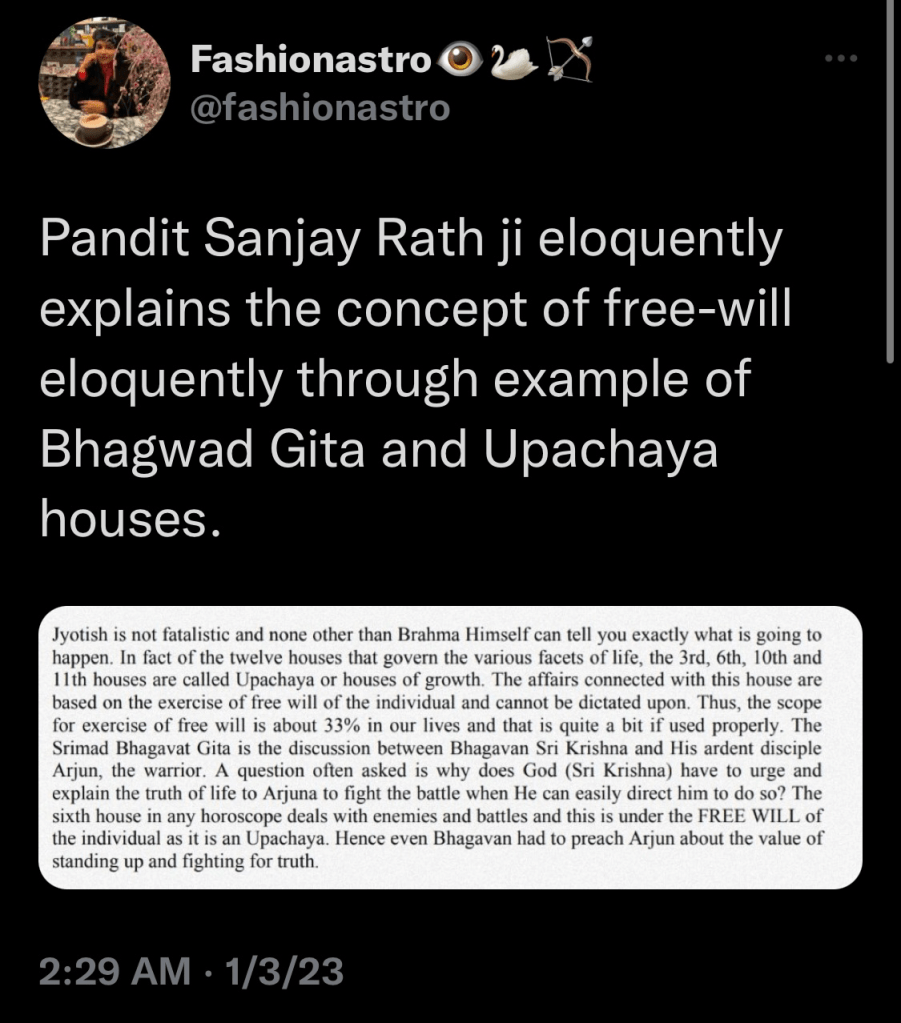
Jyotish is not fatalistic and none other than Brahma Himself can tell you exactly what is going to happen. In fact of the twelve houses that govern the various facets of life, the 3rd, 6th, 10th and 11th houses are called Upachaya or houses of growth. The affairs connected with this house are based on the exercise of free will of the individual and cannot be dictated upon. Thus, the scope for exercise of free will is about 33% in our lives and that is quite a bit if used properly… [source | Sanjay Ruth – intro to vedic astrology]
the upachaya houses in vedic astrology:
3rd House – free will of learning, developing communication skills, applying self-effort.
6th House – free will of discipline, performing service and duty, response to enemies, overcoming obstacles.
10th House – free will of responsibility, achieved social status, career growth.
11th House – free will of fulfilling aspirations, gains of income, legacy created, social sharing and social groups.
In one’s natal chart, having malefic planets or aspects to these houses may create greater frustration in exercising free will, empty houses may create feelings of lacking significant support for growth in that area of life. You can look to the planetary ruler of empty houses for guidance.
ii. four aims of life
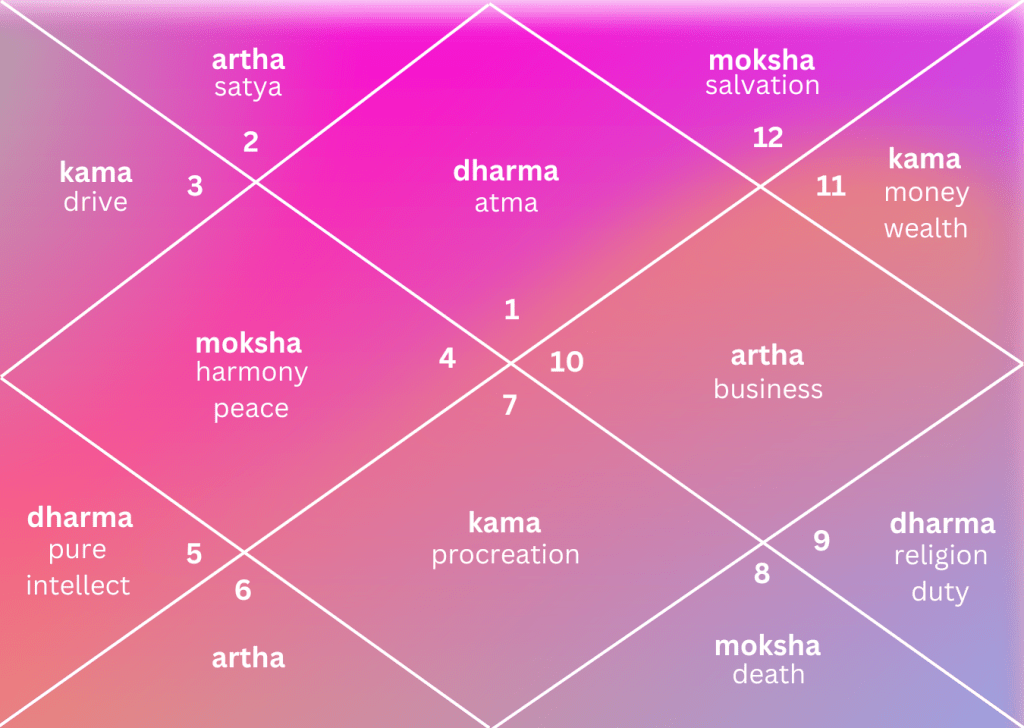
The proper aims of life in Hinduism, or Purusharthas (object of human pursuit), are the four main goals of meaningful life as a human:
dharma (1st, 5th, 9th house) – the aim of righteousness, spiritual duty, devotion.
artha (2nd, 6th, 10th house) – the aim of success in work, material wealth, providing for self.
kama (3rd, 7th, 11th house) – the aim of enjoyment, pleasure, love.
moksha (4th, 8th, 12th house) – the aim of spiritual liberation, salvation, self-realization.
In jyotish, the houses of the natal chart and each nakshatra (lunar mansion) has a specific aim. One’s natal chart provides awareness of where one’s efforts are concentrated in this lifetime, means of pursuing these aims, timeframe of potential experiences, and how to establish greater spiritual-material balance in one’s life.
In western society, we’re more than familiar with the aim of artha, the aim of obtaining material wealth through one’s efforts to provide for self and family. This is where most focus their efforts in life. To a lesser extent we value kama, the aim of pleasure and love. However this aim in complicated by the complexities of religious conditioning about pleasure, cultural devaluing of women, and less evolved understandings of love. We tend to misunderstand and underappreciate those who focus more of their intention towards dharma and moksha—morally guided action, spiritual liberation, self-realization.
iii. types of karma
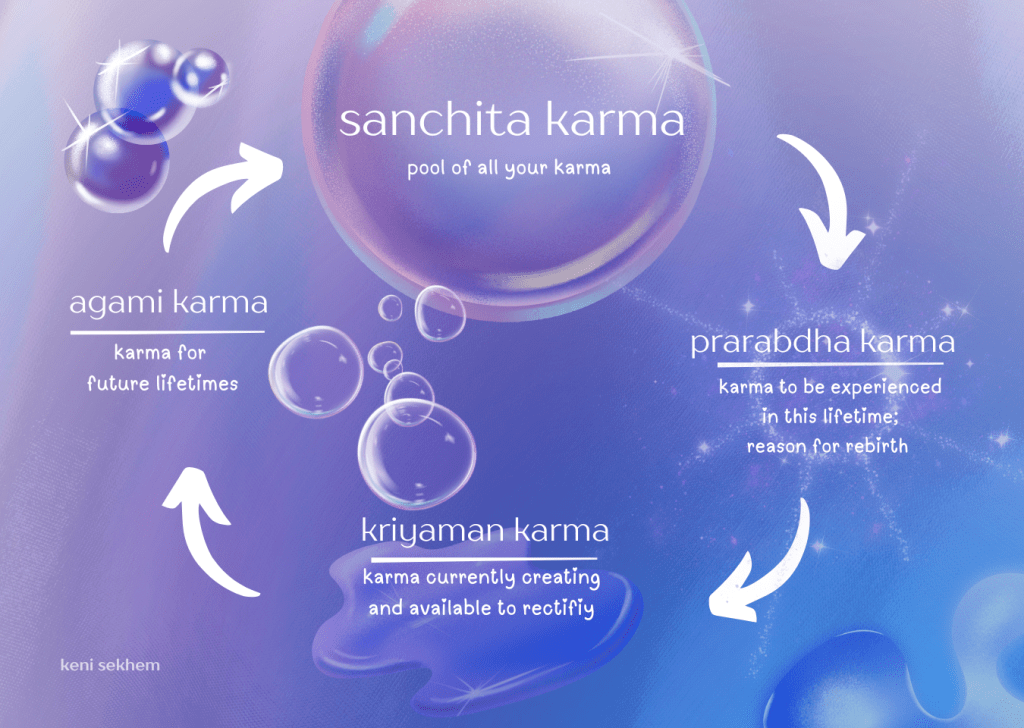
sanchita karma – is the accumulation of all our karmas (good or bad) from every lifetime. Our karmic experiences in each lifetime come from our amassed sanchita karma or pool of karma. Some karma may remain dormant in a specific lifetime, be transmuted, or later become active for us to experience.
prarabdha karma – is the karma that is manifesting from the beginning of this lifetime, it remains in motion, it is the purpose for this lifetime, must be experienced, and is beyond one’s control.
kriyaman karma – is the fruit of action, accumulated in this current life with the active potential to be nullified in this lifetime.
agami karma – is karma created by our current actions, consequences, added to our sanchita karma or pool of karma to be experienced in the future, other lifetimes, and so through intentional action we inform our future destiny.
fate + destiny
Ancient and Indigenous spiritual systems throughout the world teach that everyone has a different path to walk in life, different talents to share, different roles within our communities, personal challenges, etc. In some way, they all teach that we are to remain connected to and surrender to our personal path that has been created for us by The Great Mystery/Divine Creator/God. We do so by receiving guidance from our intuition, ancestors, elders, shamans, and Spirit to remind us of our individual path and give guidance on the proper steps to take throughout life.
However, due to things like social conditioning and religious indoctrination, many demonize the resources of metaphysical and spiritual guidance, and reject the fulfillment of following their intuitive knowing of personal dreams and aspirations.
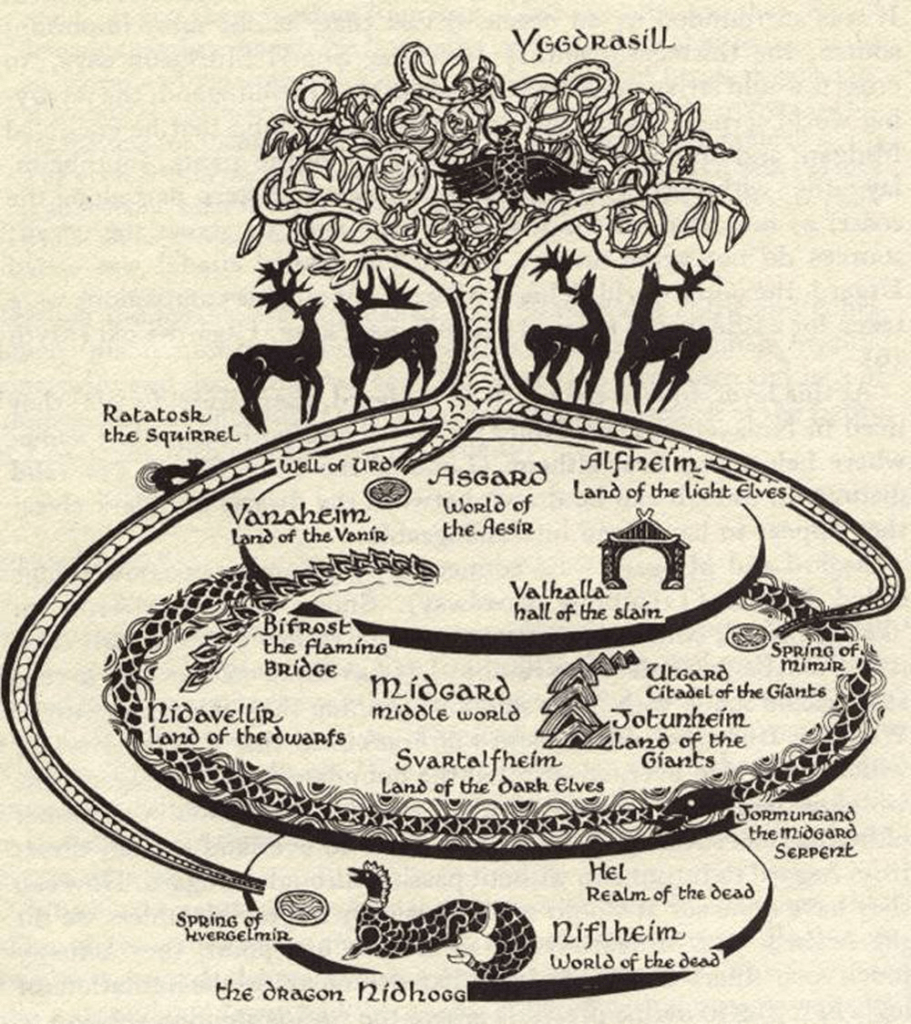
In Norse mythology, the Yggdrasil tree is similar to the cosmology of many other cultures that have belief in a ‘Tree of Life’. The Yggdrasil tree and Well of Urd is tended to by three sisters, the Norns, or wise maidens. It is believed that at the Well of Urd your fate is decided. The three Norns represent the past, present, and future. Together, along with other deities, the Norns influence what happens in your life. This cosmology of the Tree of Life is echoed by similar sentiments in other cultures throughout the world. As well as, the idea that our destiny is influenced by a higher power.
I think this connects back to what I am calling allowance of free will. Some people have the free will to explore the world and experience as much as they please, others will face great adversities that are not of their own creation and that are meant to redirect them in life, and others have a clear idea from childhood of exactly what they came here to do.
aligning with your highest potential
It doesn’t matter if you’re fatalistic or deterministic, I feel that whatever free will we have in life comes with the responsibility to challenge ourself to aspire to our highest potential while maintaining our morality. We must consider how life decisions bring us either closer or further way from self-actualization.
Life is very unpredictable, challenging, and unfair but it’s up to us to find a sense of purpose, to consider how our actions today affect not only this lifetime but future lifetimes, it’s important to find understanding and resolution to the lessons or hardships we are currently working through.
Personally, I focus the intentions of my free will on everyday actions that will anchor me within the timeline, or reality, where I am living from my highest potential. I pray, asking God to help me through the hardships and hurdles that distract me and prevent me from making progress in life. I also pray that my life remains divinely guided in its manifestation.
There may be a lot of new information for some to process. Please take your time and revisit this in the future after taking the time to integrate parts of it. I hope this wasn’t too dense or confusing and set the intention that the message of this post is received by those who seek remembrance. I tried my best to condense the many different perspectives and ideas I’ve been meditating on over the years.
Be blessed and may you live out your highest potential!✨
 keni sekhem